Showing posts with label Brighton. Show all posts

Monday, 16 May 2016

Keep playing


Kate Regester reflects on the way the art of play is driving community development.


When I walked in to the Creating Routes workshop, at Creativeworks London on 29th April, people were already sat on chairs around the edge of the room, leaving a big empty space. What’s going to happen in that space? I wondered, as I sat down and shook hands with the person next to me. I was safe in my seated position with the weight of my backpack pressing against my legs. Then the workshop facilitator stood up and invited us to leave our stuff behind and join them.

The move from the chair to the middle of the room was weirdly daunting. It was only a short distance but it was stepping into the unknown. The group had never met before, who were these facilitators? Anything could happen. It sounds like a little thing, but as the 140+ projects that were showcased as part of the Creativeworks Festival attest, when you get a group of interested people stepping into the same space the results can be huge, far-reaching and overall surprising.

One of the things that stuck with me from the day of installations, talks, performances and workshops was a comment from the panellists in Women, Creative Collaborations and Digital Thinking who said that we are brought up to believe that work is a serious business, when actually the best work comes out when we play. Something that has been recognised by the top Fortune 100 companies like Google where play is more than just an activity, it is a mindset created by a value system. Play is an attitude which promotes negotiation, creative problem solving, taking risks and reaching a consensus when our different imaginary worlds collide.

The panellists, Ghislaine Boddington (Body>Data>Space), Ruth Catlow (Furtherfield), Lydia Fraser-Ward (Fantasy High Street) and Roberta Communian (King’s College London), discussed how digital technologies, like architecture, embed our values and interests into the future whether this is through the technologies, businesses, education and art themselves or the behaviours we exhibit when using them.  With this comes the importance of providing and promoting opportunities so everyone is represented in the creative process, ensuring those values meet the needs of every future user. Alongside which is the way we, as individuals, take responsibility for championing and supporting the younger generation into the workforce.


Collaboration is another big word bouncing around at the moment and an easy answer to some of the challenges faced by all organisations in the changing funding landscape. However, it is not always so easy to achieve, precisely because it require those skills which can only be developed through play. Play is not just about what happens in closed rooms or a responsibility of a curriculum; it’s an attitude that gives people permission to experiment and when the outcome does not turn out as you expect, creating a safe space where that learning can be turned in to an opportunity. In your workplace or in that space with other interested people. 

At Brighton City Lab on 28th April, I met individuals from a range of Social Enterprises and community-minded projects across Brighton. I saw a network of people sharing experience, skills and connections, coming together with the opportunity to explore ideas. It brought home how much of our learning happens not on the chairs at the edge of the room but when we are in the middle of the room, working together.

To go back to the Creating Routes workshop, you’ll be pleased to know that the middle of the room didn’t swallow me up. The facilitators asked us to choose from a series of random objects (head torches, police line tape, small mesh hats with bells on) something that reflected one of our skills and take it back to our groups. We entered the space as individuals with something unique to offer, put our skills together and created an imaginary project. In short, we played.

Links:
http://www.creativeworkslondon.org.uk/festival
http://www.resourcecentre.org.uk/brighton-city-lab/

---

Kate Regester is the Project Development Manager at always possible
// kate@alwayspossible.co.uk


Saturday, 26 September 2015

Money Is Dead. Long Live Money.

always possible is a founding member of Goodmoney CIC, an ambitious social enterprise based in Brighton & Hove. Its main focus is on the reinvention of resilient local finance that does not rely on the conventional banking system. There will be many ways that it does this, with plans for a mutual credit system powered by independent businesses and charities, as well as a time bank that enables local individuals to exchange more of their time, skills, goods and services through a new concept of currency.

I first heard about the plans around 3 years ago, when one of the directors and I were having a conversation about apprenticeships, but it is truly remarkable to now be attending the launch of Goodmoney gift vouchers - as I was delighted to do last week. The gift voucher scheme currently involves 143 independent Brighton & Hove businesses, and is rising every day. 

They work in the same way as any other gift voucher, but with two substantial benefits: 


1. all of the businesses are independent SMEs or micro-businesses who would never otherwise be part of a multi-option gift voucher (a £5billion economy that shuts out everyone but the biggest retailers). Anyone given a voucher can spend it with a glorious range of places - coffee shops, art studios, bike repair shops, wedding DJs, cafes, printing companies, ice cream parlours, life coaches, IT support, watersports equipment hire, brewers etc etc.

2. statistically, 5% of all gift vouchers do not get redeemed - in the UK, that's around £250million per year that is counted as pure profit by big retailers. Any unspent Goodmoney vouchers will be used to fund community projects, education and health initiatives - making the impact of the vouchers infinitely more than the cash paid for them.

People can spend vouchers with my company on coaching or training in skills such as pitching ideas, writing funding applications, networking, facilitating a workshop, putting on an event, leadership and management skills or designing a project for young people (and much more). We can provide ‘critical friendship’ for people wanting to test ideas or products. 

The launch event was great fun, with many of the supporting businesses chipping in to keep costs down and entertainment high (free curry, craft beer and gramophone DJs). Brighton Pavilion MP Caroline Lucas is one of the board members overseeing the development of this scheme, and she came along to give a few words and award prizes to the children who had designed the gift cards in which the vouchers are presented - despite her party conference due to start in Bournemouth just a few hours later.

I am also working with the company on their education strategy, regularly meeting one of the directors, maths lecturer and teacher Dr Mick Taylor, on how we can use the values of the initiative to help school teachers reframe lessons on financial literacy. I am particularly interested in looking at the social impact of money and how that powers attitudes of children and young people - around their own confidence in using maths to manage every day monetary transactions, but also the consequences that social transactions like borrowing, lending, stealing, saving, spending have on an individual's concept of self worth. 

There are some complicated messages about money, debt, deficit, welfare and capital being put in and around children all the time at the moment - and I believe these might be a route in to giving practical application and context to mathematical problems so that some of the basics start to make sense.

The very small team have set themselves an extraordinary target of selling £100k of vouchers by Christmas, and £1m by 2020. If they do, they could well have something really exciting on their hands.


Wednesday, 2 September 2015

Sparks Flying About

I attended the first Spark Festival of Ideas in Brighton last year, when it was more of an idea itself, collecting a ragbag of digital and media industry entrepreneurs, educators and academics to decide whether such an event - where discussion>planning>doing is the key - had any use or value in shaping a new approach to creative learning.


What is quite remarkable, is how many pie-in-the-sky ideas generated at the 2014 gathering became transformational, tangible projects. The clearest example of which is the Maker Space on Brighton's London Rd, which is now a key part of the city's STEM learning offer and has seen 600 children through its doors making robots, using 3D printers, hacking computers and designing new games.

So, I was delighted to be invited back this year - especially as I have now gone independent and would not be representing any particular school, college or creative enterprise. 

The thought, care and attention to detail given to this event was palpable - as was the seamless mixing of 'grown-up' ideas workshops in the centre of the main hall at Brighton's Clarendon Centre, whilst 30 or so 6-16 year olds hacked, soldered, built, deconstructed and coded their hearts out at workstations around the edge of the space. 

The event is convened by Maker Club and Long Run Works, with some funding this year from the Arts Council, Brighton Digital Festival and City & Guilds. Volunteers told people where they needed to go and a bank of professional facilitators had been brought in to add some objectivity to the working groups - ensuring that local politics or delegate agendas didn't sway the discussion outcomes too much. It worked well.

The event is still in its genesis period, but the evolution of its intent and reach is quite exciting. 

The 60 or so delegates were trying to solve the following problems:


1. How do we inspire a new generation of inventors?
2. How do employers and educators join the dots?
3. How do we teach making a difference before making a margin?
4. Should we be creating ‘gender neutral’ industry cultures rather than campaigning to get more women into certain industries?
5. How do we make peace between nature and technology?

Were all the right people in the room? Of course not. But as the festival grows, it will become of more interest to young people, mainstream (head)teachers and funders/influencers - all of whom were under-represented.


And if concrete solutions were not found to each of the questions, some bloody good ideas were - one of which (for a targeted series of events that fund some facilitated time between schools/colleges and STEM businesses) will now be given £5k in research & development funding. A pretty hefty irony of the day was that, for a day of innovation centred around digital thinking, there were a ludicrous number of post-it notes in play.

I, personally, made some new and very interesting connections - with the Director of the Starr Trust and the Brighton Digital Festival Chair among others - with whom I can already see ideas for collaboration.

My wish is, in all honesty, that we can move on from a lot of these questions within the next couple of years, because they have been the same ever since I have been in this game. But something is changing, and it is not just the public and voluntary sector project workers grinding their teeth in a bid to make a difference - with often limited resources and available expertise, but the small businesses are coming forward. Small businesses with flexibility, without reliance on government funding, approaching the problem from a different angle. No single sector has a hope of answering these questions on its own - let alone do anything about it - but the cumulative and collaborative 'do-ing' and 'trying' is actually starting to shift the outcome. It does feel like the opportunity to make tangible change has just been given a new dimension - I don't know if thats just down here, or if it is just because some particular sorts of people are in the right place at the right time, but it certainly feels like this is a time to seize change.

And if I ever wake up in the middle of the night wondering what the hell I've done, and whether my ambitions to work across creative, education, small enterprise and community projects is too broad and undefined - I need to remind myself about events like this. I actually think it is vital for me to work with as many people who want to make a difference as possible, to bridge the sectors, to suggest unusual partnerships. I felt great when I left the Spark Festival - because something important is happening, and I have a small part to play in it.


Me, pitching an idea with Darren Abrahams from The Starr Trust


Tuesday, 21 July 2015

Leading by BOAT

I saw some great examples of pro-active ‘doing’ today; not waiting around for the right ducks to line up, but daring to march ahead.

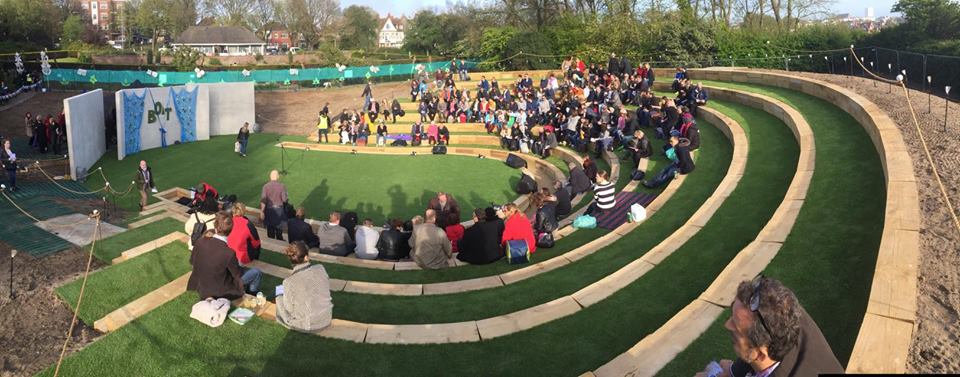
It was my first visit to the Brighton Open Air Theatre (known locally as BOAT) - a purpose-built amphitheatre tucked away at the back of Dyke Road Park on the Brighton/Hove border. The concept, design, funding and management is a true story of community, and even richer because of the legacy of its instigator - the late Adrian Bunting. The full story is here. Creating a space like this, and keeping it important, is a difficult and undoubtedly tiring thing to do, but it is a beautiful and authentic performance arena. Actors will see the whites of 420 pairs of eyes with every show, and the space commands respect for simple story-telling without hiding behind spectacle. And if it rains, everyone gets wet.


I went along today, with always possible associate James Turnbull, to discuss the idea of an outdoor theatre festival for children and young people from 2016. The concept is that of Naomi Alexander, community theatre specialist at Battersea Arts Centre and the Old Vic, who has a simple ambition to produce theatre that is accessible and vital to the 92% of the UK who never go to the theatre. 

It is early days, but around 40 people turned up to contribute ideas. Some ideas are brilliant, some rubbish, some will ferment over time. The conversations anchored around inclusion, quality, funding, community, scale, age, audience, ethos. There is expertise available and a will to action - but what Naomi is demonstrating is that good leadership does not need to wait for an opportunity; good leadership makes opportunities and invites the right people in to give it critical mass.


Friday, 17 July 2015

Curating The Noise

I've been thinking a lot this week about curation, and the art of filtering/editing in a world full of noise. 


If you're anything like me, then you'll struggle to be satisfied that you're ever reading or doing or involving yourself in enough, conscious that you're missing out on something somewhere, not part of an essential conversation happening around the corner. For people like me, social media is both the best and worst possible thing to get hooked onto.

We now lead personal and professional lives anchored in an overwhelming everness of information - there is no stimulus that isn't available immediately in some form, but we are left to rely on piecemeal or amateur curation (or worse still, we have to rely on ourselves as editors). Who, on earth, can we rely on to vet the noise, to steer us to the genuinely good stuff and to stop us wasting time?

Yesterday morning I had a long catch-up with always possible associate, Chris Middleton, an entrepreneurial journalist and magazine editor with whom I have worked for a few years. He insists that print media is far from dying, and - like vinyl records - is enjoying a role as a product that fights the endless noise; beautiful magazines are being produced about incredibly niche areas of thought, standing up as something carefully curated, assembled and informed. 

For me, the element of trust is vital and the most successful platforms on and offline are those that you know will filter the content that is useful to you. There is a great, rebellious power in being a good curator in a time when the accepted norm for media consumption is that we want everything, everywhere, from everyone, all the time. But who decides who should curate, filter and edit - if we follow a particular blog, hashtag, LinkedIn group or individual how do we know that they are not missing out on some of the vital conversations too? Does it matter? How informed do we need to be to still lead and create in our respective fields?

It might be a cliche to cling onto, but it's hard to deny that the last 5 years has overthrown traditional ideas of communication spaces and has democratised the voice of the individual - anyone can be a creator and commentator of content, and magnificent online collaborations can lead to more innovative inquiry amongst communities of people who want to make a difference. In the noise there are definitely wonderful ideas, but how do we ensure they get to supersede the awful ones? For those working in education, the possibilities are limitless, and the advent of online learning will become the single biggest tool for affecting global change - but limitless is a very daunting place to start. I want to say to my 6 year old, here is the whole universe, for you, and there is nothing you can't do within it - but by doing that, I've disabled her before she's even started. Everyone needs a curator to help guide them through it.

After my meeting pondering this, I was privileged enough to spend the sunny afternoon hanging out at Charleston, the East Sussex farmstead once inhabited by the Bloomsbury group. I shall hopefully be working as a consultant with the trust that now diligently owns and runs the site, so after my meeting with directors I snuck onto a guided tour of the house as - despite spending 4 years of dissertation writing on British modernism, Woolf and 1920s art, I had never been before. 


The place is astonishing, deceptively big although the individual rooms are small - almost every surface, wall, furniture piece, fireplace painted or stencilled with striking patterns and once bold colours. A whole building curated by Vanessa Bell and Duncan Grant for themselves and their friends and unorthodox families; a different kind of libertarian noise to that of the Internet age, perhaps antithetical to it as it was really by invite only. There is a mixture of the slapdash (paintstrokes on plaster on the wrong type of paint etc) and of the utterly precise, with contributions to the interior design evolving from 1916 through to the late 70s. The challenge for the trust is to capture the history, spirit and energy of style - a bit like a living, well-designed art magazine - whilst protecting a fragile infrastructure and making it accessible and relevant within a digital universe. 

There is a question for all of us about what role we want in the noise. And as I build my consultancy business, my own curation of advice and guidance for clients will naturally become increasingly acute, as a trusted adviser of mainstream policy and thinking, but also sniffing out the more curious and less visible conversations that may be ultimately more exciting. A goal for the next year is to come to terms with the noise, own it, distill it, filter it, make it palatable for others without over diluting it. Wish me luck.

Tuesday, 30 June 2015

A Pitch In Heat

This week I have been staring at unwieldy forms; submitting an Arts Council England application on behalf of Original Theatre Company, navigating the wordy Register of Training Organisations due-diligence and quality assurance pages, drafting another bid on leadership & management training. I end up conquering, even befriending, these endless boxes but I have to set the right conditions. Glastonbury coverage and muggy heat are not helpful conditions.

I am a conqueror. Just a hot one.


This evening I have been at the first ever Brighton RSAEngage event, an event for current and prospective Fellows of the Royal Society of The Arts to gather and drink wine and talk about changing the world. I have been a Fellow for 3 days, but felt more included than I have ever done when muscling my way in to these sort of seemingly important chinwags. It was informal and friendly; I felt able to talk to anyone, and everyone was equally flagging in the evening heat. My elevator pitch is not yet refined and goes something like: “I am an education consultant and I also work with creative and cultural organizations and the non-profit and charity sector and I support growth and strategy and help leaders be brilliant at what that they do and that is at the core of my offer, to help organisations that want to make a difference be brilliant, and that is through strategy and fundraising and coaching and consulting, I am interested in values-led leadership and how education can be broken apart and restitched as well as how the arts can fulfill a mandate for social change and I like people and I like cheese and and and and”.

I could do with some editing.

It could have been an empty talking shop, a bit elitist, a bit privileged - I’ve done those before - but it avoided this. Most people seemed as wide-eyed as me, but with a ‘thing’ that they believe in to talk about.

I might have excitedly said I will do some things with some interesting organisations - and that's what is incredibly motivating at the moment; there are some really god things happening. I met the CEO of ditchthelabel.org, a high-profile anti-bullying charity and we’re hopefully going for coffee. I enjoyed picking the brains of Naomi, who is a community theatre specialist, working with BAC and the Old Vic, who wants to establish a People’s Theatre that appeals to the 92% of people who never go to the theatre. I chatted with Lewis, who is an intern at a management consultancy that wants to transform a kiosk next to a windmill in Rottingdean into a conservation and environment education centre. I caught up with Rose who trains school governors. I spoke with Nick, a former Ofsted director, who now helps run a mentoring network for vulnerable young women and we talked about setting one up for boys. I heard from Nigel, who runs a new arts venue in Haywards Heath. I briefly introduced myself to Rowan, Director of Research & Innovation at the RSA who compelled us all to stick our noses into the deals being made about Brighton’s devolved money (the City Deal that will bring millions to the city in exchange for rapid economic growth - she is expecting an email from me about wanting to get involved. Somehow).

I’ll write soon about ‘what’ I’m doing and the philosophies that underpin it, but the scoping is still very rewarding.

Thursday, 25 June 2015

Happy Talk

The single best thing about my freelance role is the range of fascinating and interesting people I get to meet.

I'm aware that I'm doing a lot of ideas and concept building at the moment, which is always much more romantic than keeping the supporting pillars steady - but it's damn exciting.


Today, after lunch, I met with Mick Taylor. A Geordie mathematician, educator and businessman who is involved in setting up Goodmoney, a social enterprise concerned with the radical re-invention of how money works. A gift voucher that supports local businesses, a credit union that offers fair loans and a structured time bank that offers Sussex volunteers the chance to trade time/services for tickets/goods/services. I'll be hopefully playing around with them as an advisor, consultant and volunteer for the foreseeable and will see what happens; the connectivity and values-led experimenting of it all is appealing.

Then I moved straight, from hipster coffeehouse to a Costa 50 yards away, into a meeting with an account manger from JISC - the agency that supports the development of education technology in FE and HE. A great discussion that circumnavigated challenges and opportunities in the sector and how I might be able to facilitate the greatest impact with providers to test and analyse the impact of products on the market. The change of coffee shop tone is no accident.

For night-time connectivity, I took always possible associate James Turbull to London, meeting with with the great and good of charity/non-profit fundraising at a drinks reception in Farringdon. Hosted by the great James Newell of Kingston Smith, it was a good opportunity to discuss ideas of leadership, values and business with some intriguing and dynamic people; key players I enjoyed  boring with my whims were Mandy Johnson, Director of Partnerships at change.org; Paul Nott, Charity Recruitment Specialist; a freelance fundraiser called Sarah (who had kept her Minneapolis accent despite 10 years in Birmingham); Leanne from KS who partied with us near the samosas and many other warm and interesting people. 

It was quirky to have a summer party on a hot day in a windowless basement boardroom, but the beer was cool and the smiles were big.

More people, more connections, more joining up thoughts. I like this bit.